
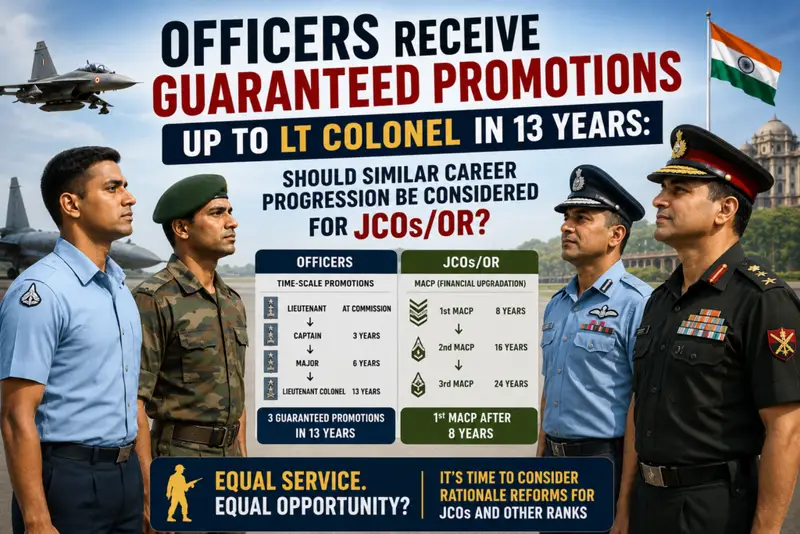
Career progression has once again become a major topic of discussion among serving personnel and veterans of the Indian Armed Forces. Many soldiers believe that while officers have a structured promotion system with multiple career milestones, Junior Commissioned Officers (JCOs) and Other Ranks (OR) often spend years waiting for financial upgradation through the Modified Assured Career Progression (MACP) Scheme. This difference has led to questions about whether the existing promotion structure treats all ranks equally. While the promotion systems for officers and JCOs/OR are designed differently because of their separate career paths, many defence personnel feel that the gap in career growth deserves a fresh review. The discussion has become more relevant as veterans’ associations and serving personnel continue to raise concerns about fairness, motivation, and long-term career satisfaction.
How Promotions Differ Between Officers and JCOs/OR
Commissioned officers generally follow a time-bound promotion structure during the early years of service. Subject to eligibility, performance, and applicable policies, many officers receive promotions to higher ranks within a defined period. In contrast, JCOs and OR mainly depend on vacancies, promotion boards, trade requirements, and service conditions. If promotions are delayed due to limited vacancies, many personnel eventually receive financial benefits through the MACP Scheme instead of an actual rank promotion. While MACP improves pay after a fixed period of service, it does not change the individual’s rank, authority, or appointment. This distinction is one of the biggest reasons why many soldiers believe that career progression is not equal across different categories of personnel.
| Career Aspect | Officers | JCOs & OR |
|---|---|---|
| Early Career Promotions | Generally structured | Vacancy-based |
| Promotion System | Time and merit based | Vacancy, merit and eligibility |
| Financial Upgradation | Promotion-based | Often through MACP |
| Rank Change | Yes | Only through actual promotion |
| Authority & Responsibility | Increase with promotion | Increase only after rank promotion |
What is MACP and Why Do Soldiers Talk About It?
The Modified Assured Career Progression (MACP) Scheme was introduced to provide financial relief to government employees, including defence personnel, who do not receive regular promotions due to limited vacancies. Under this scheme, eligible personnel receive financial upgradation after completing specified years of service if they have not earned enough promotions. However, many soldiers point out that MACP only improves salary and certain financial benefits. It does not provide the respect, command responsibility, uniform rank, or leadership opportunities that come with an actual promotion. Because of this, many JCOs and OR feel that MACP cannot completely replace a regular career advancement. Veterans have also argued that delayed promotions can affect morale, especially when personnel spend decades serving in demanding operational conditions.
| MACP Highlights | Details |
|---|---|
| Purpose | Financial upgradation |
| Rank Promotion | No |
| Salary Benefit | Yes |
| Leadership Role | No change |
| Based On | Length of service and eligibility |
Why Veterans and Serving Personnel Seek Reforms
Many retired and serving defence personnel believe that the promotion system should provide more opportunities for deserving soldiers. They argue that experienced JCOs and OR play a critical role in military operations, training, logistics, administration, and field duties. A more balanced career progression system, according to them, would improve motivation and job satisfaction while rewarding long years of dedicated service. Some experts also believe that faster promotions where vacancies permit, better cadre management, and periodic review of promotion policies could reduce dissatisfaction. At the same time, defence experts note that promotions in the armed forces are influenced by operational requirements, organizational structure, and sanctioned strength, making reforms more complex than in civilian departments.
Can the Promotion Gap Be Reduced in the Future?
The debate over career progression is likely to continue unless a balanced solution is found. Many veterans’ organizations have suggested reviewing promotion policies, expanding promotional avenues where feasible, and strengthening financial and career benefits for personnel who remain in the same rank for long periods. Others believe that improving transparency in promotion boards and increasing opportunities for skill-based advancement could also help. Any future reforms would need to balance operational efficiency with employee welfare. While officers and JCOs/OR perform different responsibilities within the military structure, ensuring that every soldier feels valued and rewarded for dedicated service remains an important objective for any modern armed force.
FAQs
1. What is the difference between promotion and MACP?
A promotion changes an individual’s rank, authority, responsibilities, and pay. MACP only provides financial upgradation when regular promotions are not available and does not change the person’s rank.
2. Do JCOs and OR receive promotions during service?
Yes. JCOs and OR receive promotions based on eligibility, vacancies, merit, medical fitness, and service requirements. However, the process is generally vacancy-based and may take longer than the structured progression available in the officer cadre.
3. Is there any official policy stating that officers always receive three promotions in 13 years?
Promotion timelines vary depending on service rules, eligibility, performance, vacancies, and government policies. While officers generally have a more structured early-career promotion path, promotions are not automatic and remain subject to the applicable regulations in force.