
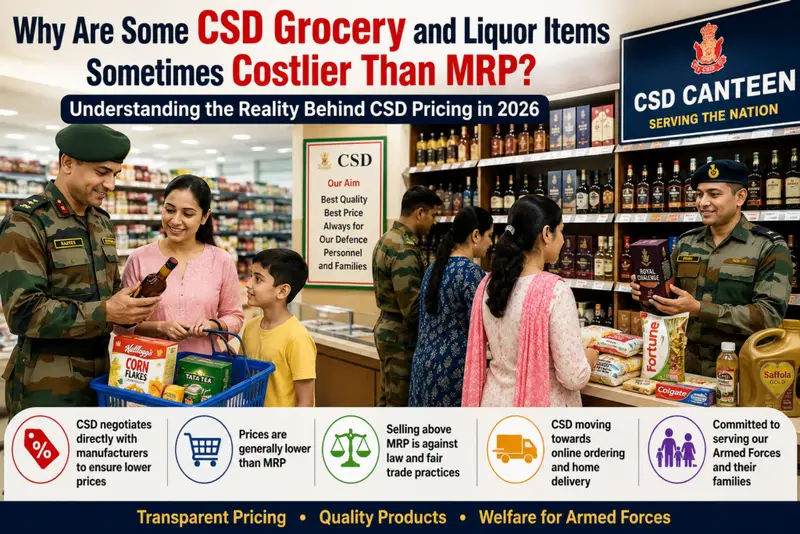
Canteen Stores Department (CSD) facilities are designed to provide groceries, household products, and liquor to eligible Armed Forces personnel, Ex-Servicemen, and their families at comparatively favourable prices. Still, many beneficiaries occasionally notice a CSD item that appears to be priced higher than the MRP seen in the civilian market. This naturally raises a question: if CSD is meant to provide affordable products, how can the price sometimes look higher? The answer is not always as simple as comparing two numbers on a shelf. Product batches, revised MRPs, taxes, local market prices, CSD pricing arrangements, and the way a product is displayed can all create confusion. In some cases, the CSD price may genuinely be higher than a current shop price because the civilian retailer is offering a discount, while in other cases the comparison itself may not be between identical products or price labels.
| Price Factor | What It Can Mean |
|---|---|
| Printed MRP | Maximum retail price printed on the product |
| CSD Price | Price applicable through the CSD system |
| Market Price | Price offered by a civilian retailer |
| Discount Price | Temporary reduction below printed MRP |
| Revised MRP | New price after a manufacturer revision |
Why a Civilian Shop Can Sometimes Sell the Same Product Cheaper
One of the biggest reasons for confusion is that MRP and actual selling price are not the same thing. MRP is the maximum retail price printed by the manufacturer, while a shop may legally offer the product at a lower price as a discount. For example, a product carrying an MRP of ₹500 might be available at a civilian supermarket for ₹450 during a promotional sale. If the CSD price is ₹460, a beneficiary may feel that CSD is more expensive. However, the comparison is actually between a CSD selling price and a temporary civilian discount price. Online platforms can create another layer of confusion because they frequently run special offers, cashback schemes, bulk discounts, or clearance sales. Therefore, a higher CSD price compared with a discounted market price does not automatically mean that the CSD system has charged more than the product’s MRP.
How MRP Revisions and Old Stock Create Price Differences
Manufacturers periodically revise product prices because of changes in raw-material costs, transportation expenses, packaging costs, taxes, or other commercial factors. When this happens, older and newer batches of the same product may be available in the market at the same time. Their printed MRPs can therefore be different. CSD depots and dependent canteens also have inventory that moves through the supply chain at different times. A beneficiary may see an older batch at one location and a newly revised product in another place. Liquor prices can be even more complicated because taxation and pricing policies differ from state to state. A bottle with the same brand name may therefore have different final prices in different states. This is one reason why beneficiaries should compare the exact product, bottle size, batch information, and applicable price rather than relying only on the brand name.
| Reason for Difference | Possible Effect |
|---|---|
| Manufacturer Price Revision | New MRP may be higher |
| Old and New Stock | Different printed prices |
| State Taxes | Different liquor prices |
| Promotional Discount | Civilian price may temporarily fall |
| Pack Size Difference | Similar-looking products may have different prices |
Liquor Pricing Requires Special Attention
Liquor is one category where CSD beneficiaries often notice significant price differences between locations. Unlike ordinary grocery products, liquor pricing is strongly influenced by state excise policies, duties, fees, and local regulations. The same brand can therefore have different prices in different states. CSD procurement and pricing arrangements also operate within the applicable rules and supply structure. A comparison between a CSD liquor price in one state and a retail price in another state may not provide a meaningful picture. Beneficiaries should check the exact bottle size, brand variant, state-specific price, and the price displayed by the authorised CSD outlet. If a bottle appears to have been sold above its applicable permissible price, the beneficiary should preserve the bill and product details and raise the matter with the appropriate CSD authority rather than relying on rumours or social-media claims.
What CSD Beneficiaries Should Check Before Complaining About a Price
Before concluding that a CSD grocery or liquor item is overpriced, beneficiaries should take a few simple steps. First, check the MRP printed on the product and compare it with the actual amount shown on the CSD bill. Next, make sure the product size and variant are exactly the same as the one being compared in the civilian market. A 500-gram pack and a 550-gram pack can look almost identical but have different prices. Buyers should also check whether the civilian shop is offering a temporary promotional discount. For liquor, the state and bottle size should always be considered. If there is a genuine discrepancy between the applicable price and the amount charged, keeping the purchase receipt, product photograph, and batch details can make it much easier for the complaint to be examined. CSD beneficiaries should remember that an item being cheaper outside the canteen does not automatically prove that CSD pricing is incorrect.
The Reality Behind CSD Pricing in 2026
The basic purpose of CSD remains to provide eligible beneficiaries access to a wide range of products at favourable prices. However, “CSD price” should not always be understood as “the lowest price available anywhere in the market.” Civilian retailers can temporarily sell products below MRP, manufacturers can change prices, and different states can impose different taxes, especially on liquor. At the same time, genuine pricing mistakes or billing discrepancies should not be ignored. The best approach is to compare identical products using the printed MRP, CSD bill, pack size, batch details, and current local market price. This gives Ex-Servicemen and serving personnel a clearer picture and prevents unnecessary confusion. If a price appears genuinely incorrect, the proper complaint channel and purchase documents should be used so that the matter can be checked by the concerned authority.
FAQs
1. Can a CSD item legally be sold above its printed MRP?
The printed MRP is generally the maximum retail price applicable to a packaged product, so beneficiaries should check the product label and bill carefully if the amount charged appears higher than the applicable MRP. Any suspected overcharging should be reported through the appropriate channel.
2. Why can a civilian shop sometimes be cheaper than CSD?
A civilian retailer may offer a temporary discount, online promotion, cashback, or clearance price below MRP. Therefore, a lower civilian selling price does not necessarily mean that the CSD price is incorrect.
3. Why are liquor prices different between CSD locations?
Liquor pricing is affected by state-specific excise duties, taxes, fees, distribution arrangements, bottle size, and other local rules. As a result, the price of the same brand can differ between states and locations.