
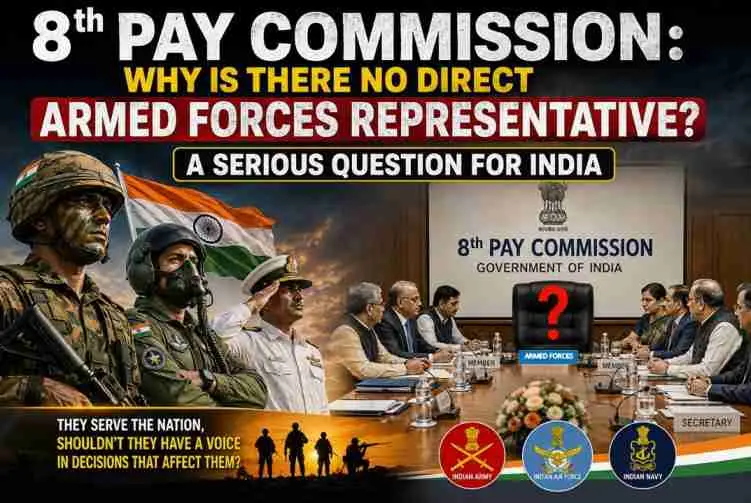
The 8th Pay Commission has become an important topic for government employees, pensioners, and members of the Armed Forces. While discussions around salary revision, allowances, pension, and service conditions are gaining attention, one question is being repeatedly raised by the defence community: why is there no direct representative of the Armed Forces on the Pay Commission? Defence personnel have unique working conditions that are very different from those of civilian employees. Soldiers may serve in high-altitude areas, difficult operational locations, field formations, and remote stations, often with strict restrictions on their personal and professional lives. Because of these special circumstances, many believe that the pay commission should have a strong and direct understanding of military service before making recommendations affecting serving personnel, JCOs, ORs, officers, and defence pensioners.
| Key Issue | Why It Matters |
|---|---|
| Armed Forces Representation | Defence-specific issues can be properly presented |
| Pay Revision | Affects serving personnel and pensioners |
| Allowances | Linked to difficult and operational postings |
| Pension | Directly affects millions of veterans and families |
Military Service Is Different From Civilian Government Employment
The main argument behind the demand for direct Armed Forces representation is simple: military service comes with responsibilities and restrictions that are not normally found in civilian employment. A soldier can be ordered to move to another location at short notice, serve away from family for long periods, and work in extreme weather or operational conditions. Personnel may also face restrictions regarding transfers, outside employment, collective bargaining, and other normal employment choices. These factors have a direct connection with compensation and career progression. A pay structure that works well for a civilian department may not fully reflect the realities of military life. Therefore, defence personnel and veterans want their concerns to be examined from a military perspective rather than being treated only as another category of government employees.
What Defence Personnel and Veterans Want the Commission to Examine
The demand for better representation is not limited to basic salary. Defence personnel have several service-specific issues that need careful examination. These include military service pay, risk and hardship allowances, field area benefits, disability-related compensation, promotion structures, pension parity, retirement benefits, and the impact of short service on long-term financial security. Veterans also want pension-related matters to be considered alongside the changing pay structure of serving personnel. Family pensioners and disabled veterans can have additional concerns that require specialised understanding. A direct defence voice could help explain how these issues affect people at different ranks and stages of service.
| Defence Issue | Possible Area of Review |
|---|---|
| Military Service Pay | Compensation for unique service conditions |
| Risk & Hardship | Difficult and operational postings |
| Pension | Retirement income and revision |
| Disability Benefits | Compensation and related support |
| Career Progression | Promotion and service structure |
Why JCOs, ORs and Veterans Need Special Attention
Another important concern is that the impact of Pay Commission recommendations is not identical across all ranks. Officers, Junior Commissioned Officers, and Other Ranks have different career structures, promotion opportunities, responsibilities, and retirement patterns. A Havildar, Naib Subedar, Subedar, or an officer may face very different financial consequences from changes in pay levels, increments, promotion policies, and pension calculations. Veterans also point to the relatively early retirement of many personnel in the lower ranks, which means they may spend a significant part of their lives outside military service. Any pay and pension recommendations should therefore consider the complete career cycle rather than focusing only on the monthly salary of a serving employee.
Is the Absence of a Direct Representative a Problem?
Whether the absence of a dedicated Armed Forces member creates a problem ultimately depends on how effectively defence-specific views are placed before the Commission. Even without a serving military officer as a formal member, the Commission can receive representations, data, evidence, and recommendations from defence organisations, ministries, service headquarters, associations, and pensioner groups. However, veterans argue that direct representation would provide an additional layer of understanding and ensure that military issues receive sufficient attention during discussions. The concern is not necessarily about giving the Armed Forces special treatment, but about ensuring that their unique service conditions are properly understood before decisions are made.
What Could Happen Next for Defence Employees and Pensioners
The 8th Pay Commission process will be closely watched by serving personnel and veterans because its recommendations could influence future pay, allowances, pension, and related benefits. The defence community is likely to continue submitting representations on issues that have remained important for years. For personnel and pensioners, the most important thing is to distinguish between confirmed decisions and demands or proposals being discussed publicly. Until the Commission submits its recommendations and the government takes a final decision, figures circulating on social media should not be treated as official. The demand for direct Armed Forces representation, however, highlights a genuine concern: defence personnel perform a specialised national-security role, and their unique working conditions deserve detailed consideration whenever a new pay structure is designed.
FAQs
1. Why are defence personnel asking for direct representation in the 8th Pay Commission?
Defence personnel and veterans believe that military service has unique conditions, including operational duties, difficult postings, early retirement, and service restrictions. They want these factors to receive direct and specialised consideration.
2. What issues could a defence representative highlight?
A defence representative could help explain issues involving military service pay, risk and hardship allowances, promotion structures, pension, disability benefits, retirement conditions, and the different career patterns of officers, JCOs, and Other Ranks.
3. Does the absence of a direct Armed Forces member mean defence issues will be ignored?
Not necessarily. Defence-related representations can still be submitted through the appropriate authorities and organisations. However, veterans argue that having direct Armed Forces representation would provide stronger specialist input during the Pay Commission process.