
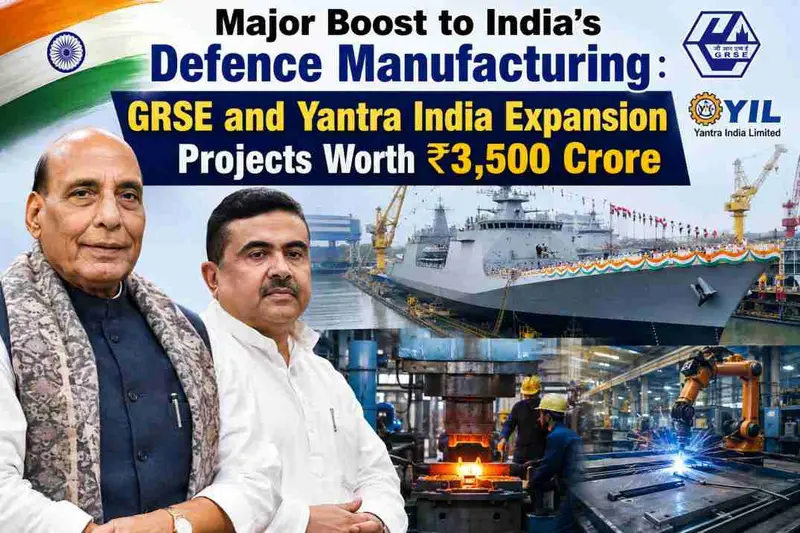
India’s defence manufacturing sector has received a major boost with the foundation being laid for five expansion projects of Garden Reach Shipbuilders & Engineers (GRSE) and Yantra India Limited (YIL) in West Bengal. The projects, together, involve an investment of around ₹3,500 crore and are aimed at increasing the country’s capacity in shipbuilding, ship repair, metallurgy and defence production. Defence Minister Rajnath Singh and West Bengal Chief Minister Suvendu Adhikari participated in the foundation ceremony in Kolkata on August 23, 2026. Three projects belong to GRSE, while two are being developed by Yantra India. The expansion is being seen as an important step towards strengthening domestic defence production and reducing dependence on imports. (The Times of India)
| Key Details | Information |
|---|---|
| Total Investment | Around ₹3,500 crore |
| Organisations | GRSE and Yantra India |
| Total Projects | 5 |
| GRSE Projects | 3 |
| Yantra India Projects | 2 |
| Location | West Bengal |
GRSE Expands Shipbuilding and Ship Repair Capacity
GRSE, a major defence shipyard and a Navratna Defence PSU, is undertaking three of the five projects. The facilities are located at Kidderpore in Kolkata, Shalimar in Howrah and Raichak in South 24-Parganas. One of the most important developments is the planned expansion at Raichak, where GRSE has access to a 32-acre riverside property. The project is expected to develop the location into a major shipbuilding hub and strengthen the company’s ability to construct and refit warships. The expansion will also support the construction and repair of small and medium-sized commercial vessels. This is particularly important at a time when India is trying to increase its shipbuilding capacity and compete more strongly in the international maritime market. (@theweek)
| GRSE Location | Main Focus |
|---|---|
| Kidderpore, Kolkata | Shipbuilding capacity |
| Shalimar, Howrah | Shipbuilding and repair |
| Raichak | Major shipbuilding hub |
| Combined GRSE Expansion | Warships and commercial vessels |
Yantra India to Strengthen Strategic Metallurgical Production
The other two projects are being developed by Yantra India Limited at its Metal and Steel Factory in Ishapore. These facilities are expected to strengthen India’s domestic metallurgical and production capabilities for strategically important sectors. Yantra India already manufactures a wide range of defence-related products, including components and assemblies for ammunition, armoured vehicles, artillery guns and main battle tanks. The company has also expanded into products such as carbon-fibre composites, glass composites and aluminium alloys. In February 2026, Yantra India was granted Miniratna Category-I status, reflecting its growth as a profit-making defence public sector company. Its sales increased from ₹956.32 crore in 2021-22 to ₹3,108.79 crore in 2024-25, while exports also reached ₹321.77 crore in 2024-25. (Press Information Bureau)
| Yantra India Focus | Expected Importance |
|---|---|
| Metallurgy | Stronger domestic production |
| Defence Components | Reduced import dependence |
| Advanced Materials | Support for modern platforms |
| Production Capacity | Higher output potential |
Why the ₹3,500 Crore Projects Matter for Aatmanirbhar Bharat
The expansion comes at a time when India is placing a strong focus on Aatmanirbharta in defence. Increasing domestic production means India can develop and manufacture more critical equipment within the country instead of depending heavily on foreign suppliers. The projects are also expected to create opportunities for private companies, suppliers and MSMEs connected with the defence manufacturing ecosystem. GRSE officials have said the expansion can support employment generation and provide increased opportunities for ancillary industries. This could be particularly useful for West Bengal, where the projects may strengthen the industrial ecosystem around shipbuilding, engineering and defence manufacturing. (ThePrint)
India Eyes Global Shipbuilding Opportunity
Defence Minister Rajnath Singh has said India has the potential to become a global hub for ship design and shipbuilding. According to the minister, global demand for naval vessels, cargo ships and oil tankers is increasing, while traditional shipbuilding nations have seen their production capacity decline. This creates an opportunity for India to expand its own shipbuilding industry and serve both domestic and international markets. The new GRSE projects could play an important role in this effort by adding capacity for warships, repairs and commercial vessels. Along with Yantra India’s metallurgy expansion, the ₹3,500 crore programme represents a broader push to build a stronger domestic defence industrial base. (The Times of India)
What This Expansion Means for India’s Defence Future
The five projects are more than just new industrial facilities. They represent an effort to build long-term manufacturing capacity that can support India’s Armed Forces, create jobs and strengthen the country’s position in the global defence market. GRSE’s growing shipbuilding capability can support the Navy and maritime industry, while Yantra India’s expanded production capabilities can help supply critical materials and components. The projects also fit into the government’s wider Make in India and Make for the World approach. If implemented successfully, they could help India move from being primarily a defence equipment buyer to becoming a larger producer and exporter of advanced defence products. (EBS PublicNow)
FAQs
1. What is the total investment in the GRSE and Yantra India expansion projects?
The five expansion projects in West Bengal involve an investment of approximately ₹3,500 crore.
2. How many projects are being developed by GRSE and Yantra India?
There are five projects in total. GRSE is developing three facilities, while Yantra India is undertaking two projects at its Metal and Steel Factory in Ishapore.
3. How will these projects help India’s defence sector?
The projects are expected to increase shipbuilding, ship repair, metallurgical and defence manufacturing capacity. They can also support Aatmanirbharta, reduce import dependence, create employment and provide more opportunities for domestic defence industries and MSMEs.