
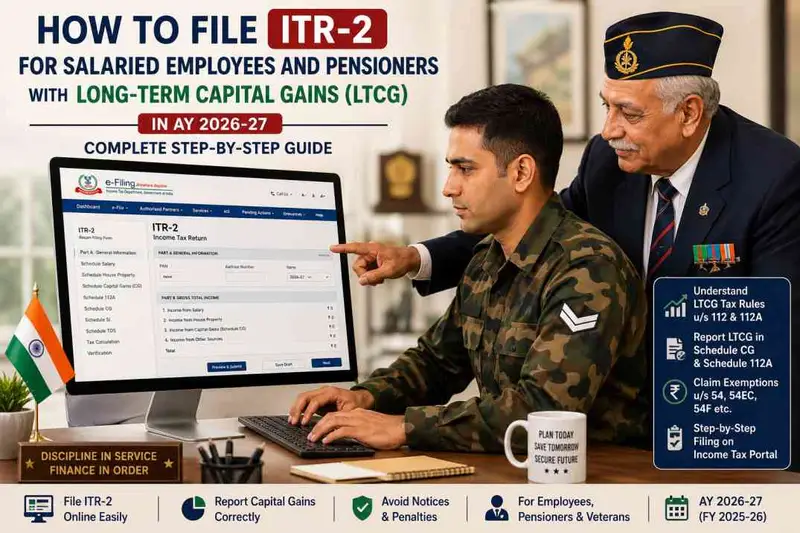
Filing an Income Tax Return (ITR) can seem confusing, especially when you have income from more than one source. For the Assessment Year (AY) 2026-27, salaried employees and pensioners who have earned Long-Term Capital Gains (LTCG) from the sale of shares, mutual funds, property, or other eligible assets generally need to file ITR-2 instead of ITR-1. Choosing the correct form is important because filing the wrong return may lead to processing delays or the need to file a revised return later. The ITR-2 form has been designed for individuals and Hindu Undivided Families (HUFs) who do not have income from business or profession but have income from capital gains and other specified sources. Understanding the filing process in advance can help taxpayers complete their returns accurately and avoid last-minute mistakes.
Who Should File ITR-2 for AY 2026-27?
ITR-2 is meant for individuals whose income does not fall under business or professional income but includes other categories that cannot be reported in ITR-1. Salaried employees and pensioners who have earned long-term capital gains during the financial year should generally use this form if they meet the applicable eligibility conditions. It is also used by taxpayers who own more than one house property, have foreign assets or foreign income, or have income that exceeds the limits prescribed for simpler return forms.
Before filing the return, taxpayers should keep all necessary documents ready. These include Form 16 issued by the employer, Annual Information Statement (AIS), Form 26AS, bank account details, interest certificates, capital gains statements provided by brokers or mutual fund companies, and records of property transactions wherever applicable. Having all documents available makes the filing process easier and reduces the chances of errors.
Step-by-Step Process to File ITR-2
Filing ITR-2 online is straightforward if the required information is collected beforehand. Taxpayers should carefully verify every entry before submitting the return to avoid notices or delays during processing.
| Step | Action Required |
|---|---|
| 1 | Log in to the Income Tax e-filing portal |
| 2 | Select Assessment Year 2026-27 |
| 3 | Choose ITR-2 as the applicable return form |
| 4 | Enter personal and income details |
| 5 | Report salary, pension, interest, and LTCG details |
| 6 | Claim eligible deductions and tax credits |
| 7 | Verify tax calculation and submit the return |
| 8 | Complete return verification through the available verification methods |
While entering capital gains, taxpayers should ensure that the purchase date, sale date, acquisition cost, sale consideration, exemptions, and indexation benefits, wherever applicable under the Income-tax Act, are reported correctly.
Reporting Long-Term Capital Gains Correctly
One of the most important sections in ITR-2 is the reporting of long-term capital gains. LTCG may arise from the sale of listed shares, equity-oriented mutual funds, land, buildings, or other capital assets. The tax treatment depends on the nature of the asset, the applicable holding period, and the relevant provisions of the Income-tax Act.
Taxpayers should carefully reconcile their capital gains statement with their broker reports, Annual Information Statement (AIS), and Form 26AS wherever applicable. Incorrect reporting of sale value, purchase price, or exemption claims may result in mismatches during return processing. Those claiming exemptions under the applicable provisions should maintain supporting documents for future reference. Double-checking all figures before submission can save considerable time later.
Common Mistakes to Avoid While Filing ITR-2
Many taxpayers make small mistakes that can delay the processing of their returns. One common error is selecting the wrong ITR form even when long-term capital gains are involved. Another frequent mistake is failing to match salary income, tax deducted at source (TDS), and capital gains with the details available in official tax records.
Some other points to remember include:
- Verify PAN, Aadhaar, and personal information carefully.
- Match Form 16 with salary details entered in the return.
- Check Form 26AS and AIS before submitting the return.
- Report all bank accounts held during the financial year.
- Enter capital gains exactly as supported by transaction records.
- Claim deductions only if they are supported by valid documents.
- Verify the return after submission, as an unverified return is treated as incomplete.
By taking a little extra time to review every section, taxpayers can file an accurate return and avoid unnecessary complications.
FAQs
1. Who should file ITR-2 for AY 2026-27?
Salaried employees and pensioners who have long-term capital gains and do not have income from business or profession generally need to file ITR-2, subject to the applicable Income-tax rules.
2. Can I file ITR-1 if I have Long-Term Capital Gains?
If your income includes long-term capital gains that are not eligible to be reported in ITR-1, you should use ITR-2 instead of ITR-1.
3. What documents are required for filing ITR-2?
Important documents include Form 16, Form 26AS, Annual Information Statement (AIS), bank account details, capital gains statements, interest certificates, and any records supporting deductions or exemption claims.