
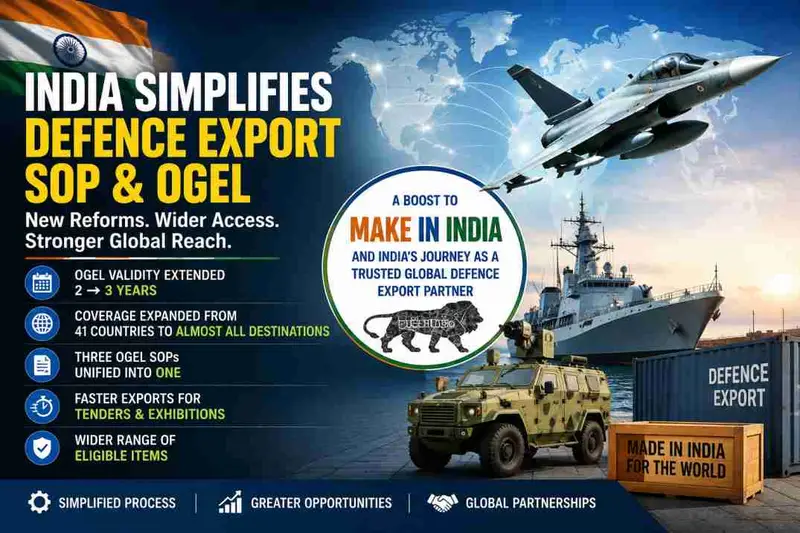
India is taking another step to make defence exports easier for domestic manufacturers by simplifying procedures connected with defence export Standard Operating Procedures (SOPs) and the Open General Export Licence (OGEL) framework. The move is important for Indian defence companies, particularly private manufacturers and smaller firms that want to enter international markets. For years, Indian defence exports have been growing, but exporters have also had to deal with several approvals, documentation requirements and compliance procedures. A simpler system could reduce some of this administrative burden and make it easier for eligible companies to serve overseas customers.
The broader objective is to support India’s growing defence manufacturing ecosystem and encourage Indian companies to look beyond the domestic market. Defence products such as ammunition, weapons systems, components, electronic equipment, protective equipment and aerospace-related products can have significant export potential. At the same time, defence exports remain a sensitive area, so simplification does not mean removing government oversight. Exporters still have to comply with applicable laws, licensing conditions and end-user requirements.
What Is the OGEL Framework?
The Open General Export Licence, commonly known as OGEL, is designed to provide eligible exporters greater flexibility for specified defence-related exports to permitted destinations. Instead of requiring a separate licence for every individual shipment covered by the licence conditions, an OGEL can allow qualifying exporters to make multiple exports of specified items to specified countries, subject to the applicable conditions.
This can be particularly useful for manufacturers that regularly supply components or other permitted defence products to overseas customers. A predictable licensing framework can help businesses plan production, negotiate contracts and manage delivery schedules more efficiently. However, OGEL is not a blanket permission to export any defence product to any country. The items, destinations and conditions covered by the relevant licence remain important, and exporters must maintain proper records and follow compliance requirements.
Key Changes and Specifications at a Glance
The simplified approach is expected to make the defence export process more practical for eligible Indian manufacturers and exporters. The exact requirements depend on the product, destination, exporter and applicable government permissions.
| Area | What It Means |
|---|---|
| Defence Export SOP | Simplification of procedures and documentation |
| OGEL | Easier framework for eligible repeat exports |
| Main Beneficiaries | Indian defence manufacturers and exporters |
| Compliance | Exporters must continue following applicable rules |
| End-User Requirements | Proper end-user and destination checks remain important |
| Export Scope | Depends on approved items and permitted destinations |
| Government Oversight | Continues for sensitive defence exports |
| Main Objective | Encourage defence manufacturing and exports |
Why the Change Matters for Indian Defence Companies
For a defence manufacturer, time is an important business factor. International buyers generally expect suppliers to provide products within agreed schedules, and delays caused by complicated administrative procedures can make it harder for smaller Indian companies to compete with established global suppliers. Simplifying the export process could therefore improve India’s attractiveness as a defence manufacturing and sourcing destination.
The change can also benefit startups and small and medium-sized enterprises (SMEs). Many smaller companies have developed specialised products, including defence electronics, drones, components, surveillance equipment, protective systems and other technologies. However, they may not have large compliance teams to handle complicated export procedures. A more straightforward framework could allow such businesses to spend more time on manufacturing, research and product development.
At the same time, companies cannot treat the simplified process casually. Defence exports involve national security considerations, and exporters must know exactly what they are permitted to send, where they can send it and under what conditions.
A Boost for India’s Defence Export Ambitions
India has been trying to build itself into a major defence manufacturing and export hub. Increasing exports can support domestic production, create skilled employment and encourage companies to invest more in research and development. It can also help Indian manufacturers gain experience by competing in international markets.
The government has repeatedly encouraged the private sector to participate more actively in defence production. A simpler export framework fits into this larger effort. When companies can understand export rules more easily and complete necessary procedures with less administrative difficulty, they are more likely to explore foreign markets.
However, the real impact will depend on how smoothly the revised procedures work in practice. Manufacturers will need clear guidance, predictable approvals and effective digital systems. Industry also needs confidence that compliance requirements will remain transparent and consistent.
What Manufacturers Should Do Next
Indian defence manufacturers interested in exports should first understand whether their products and proposed destinations fall within the applicable OGEL or other export permissions. Companies should also maintain accurate technical descriptions, customer information, end-user documentation and shipment records.
Manufacturers should not assume that every defence item qualifies automatically for an open licence. Sensitive products or particular destinations may continue to require specific government approval. Companies should therefore carefully review the latest government instructions before entering into an export contract or dispatching defence-related products.
Overall, the simplified SOP and OGEL approach represents an important step towards creating a more business-friendly defence export environment. If implemented effectively, it could reduce unnecessary paperwork, improve predictability and help more Indian manufacturers compete internationally while maintaining the security checks required for defence trade.
Frequently Asked Questions
1. What is OGEL in defence exports?
OGEL stands for Open General Export Licence. It provides eligible exporters permission to export specified defence items to permitted destinations under defined conditions, potentially reducing the need for separate permissions for every eligible shipment.
2. Does a simplified OGEL mean all defence products can be exported freely?
No. OGEL applies only to items, destinations and conditions covered by the applicable licence. Sensitive products or exports outside the permitted scope may still require separate government approval.
3. How can Indian manufacturers benefit from the new framework?
A simpler export process can reduce administrative work, improve shipment planning and make it easier for manufacturers, startups and SMEs to explore international defence markets while continuing to meet government compliance requirements.