
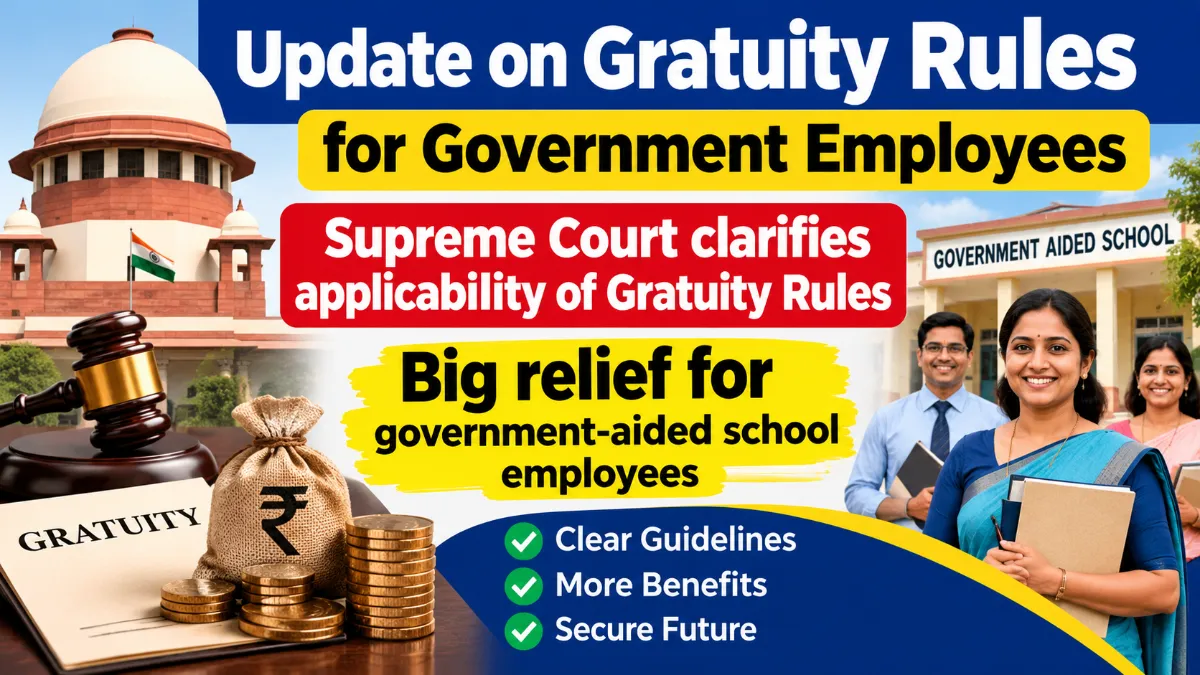
The Supreme Court has given an important clarification on gratuity and retirement benefits for employees working in government-aided schools. The ruling is particularly important for aided-school teachers and their families because it explains whether their gratuity should be calculated under the Payment of Gratuity Act, 1972 or under the applicable state service rules. The case involved a teacher from a government-aided school in Maharashtra whose legal heir had claimed gratuity under the Payment of Gratuity Act. The Supreme Court ultimately held that the retirement benefit in that case was to be dealt with under the Maharashtra Civil Services (Pension) Rules, 1982.
The judgment was delivered on July 14, 2025, by a bench of Justices Sudhanshu Dhulia and K. Vinod Chandran. The Court looked at the nature of the aided-school post, the government-approved service conditions and the fact that pay and other benefits were governed by state rules. The decision is important because it shows that simply working in an aided school does not automatically mean that every employee will claim gratuity under the Payment of Gratuity Act. The applicable service rules can play a major role.
Why Government-Aided School Employees Are Affected
Government-aided schools are not exactly the same as ordinary government departments, but their employees can receive several benefits under government-approved rules. In the Maharashtra case, the Supreme Court observed that aided-school teachers are, for practical purposes, akin to posts under the State Government when it comes to pay, allowances, pension and other retirement benefits.
The Court noted that aided-school posts may be sanctioned or approved by the government and that pay and allowances are paid by the government. Their service conditions can also be governed by rules framed under Article 309 of the Constitution. Because of these factors, the Court held that the teacher’s gratuity in the case should be granted under the applicable state pension rules rather than under the Payment of Gratuity Act, 1972.
| Particular | Details |
|---|---|
| Supreme Court decision | July 14, 2025 |
| Case | Vikram Bhalchandra Ghongade v. The Headmistress Girls High School |
| Main issue | Applicability of gratuity rules |
| School type | Government-aided school |
| Applicable rules in case | Maharashtra Civil Services (Pension) Rules, 1982 |
What This Means for Gratuity Claims
The biggest point for employees and their families is that the applicable gratuity framework may depend on the service rules governing the particular post. The Supreme Court did not simply say that every aided-school employee across India must receive gratuity under one particular set of rules. Instead, the ruling turned on the specific service structure applicable to the Maharashtra aided-school teacher involved in the case.
The Court also considered the exclusion contained in Section 2(e) of the Payment of Gratuity Act. This provision excludes certain people who hold government posts or are governed by other laws or rules providing gratuity. The Court found that the aided-school teacher’s post was sufficiently connected with the state service framework for the retirement benefit to be considered under the applicable Maharashtra rules.
This distinction is important because employees should not assume that the Supreme Court judgment automatically changes the gratuity calculation for every government-aided school in every state. State-specific rules, appointment conditions and pension provisions still need to be checked.
Big Relief for Employees and Their Families
For families of aided-school employees, the judgment provides an important legal clarification. In the case before the Supreme Court, the appellant was the legal heir of a deceased teacher and had sought gratuity under the 1972 Act. The Court modified the relief and permitted the appellant to approach the concerned authority for payment of Death-cum-Retirement Gratuity under the 1982 Rules, subject to the conditions mentioned in the judgment.
This means that where an employee is covered by a state service or pension framework, the family may have to claim retirement or death benefits under those rules rather than automatically filing a claim under the general gratuity law.
Employees Should Check Their Service Rules
The Supreme Court’s ruling is a reminder that government-aided school employees should keep their appointment letters, service records, pension documents and details of the applicable state rules safely. Before making a gratuity claim, employees or their legal heirs should first establish which rules govern their particular post.
This becomes especially important when an employee retires or dies in service and the family has to claim gratuity, pension, provident fund or other retirement benefits. A claim filed under the wrong provision can lead to unnecessary delays.
The judgment also adds to the broader legal discussion on gratuity for employees who are covered by government service rules. In another 2026 Supreme Court decision concerning Heavy Water Plant employees, the Court again examined the exclusion under Section 2(e) of the Payment of Gratuity Act where employees were governed by government pension rules.
FAQ
1. Does the Supreme Court judgment apply to all government-aided school employees in India?
Not automatically. The July 14, 2025 judgment concerned an aided-school teacher in Maharashtra and the applicable Maharashtra pension rules. Employees in other states should check the service and pension rules applicable to their own institution and post.
2. Does this mean aided-school employees will not get gratuity?
No. The judgment does not mean that gratuity or retirement benefits are denied. In the Maharashtra case, the Supreme Court directed that the benefit be considered under the Maharashtra Civil Services (Pension) Rules, 1982 rather than under the Payment of Gratuity Act, 1972.
3. What should an employee do before claiming gratuity?
The employee or family member should first check the appointment conditions, applicable state service rules, pension rules and service records. If there is uncertainty, the concerned education department or competent authority should be approached to determine the correct rule under which the gratuity claim should be made.