
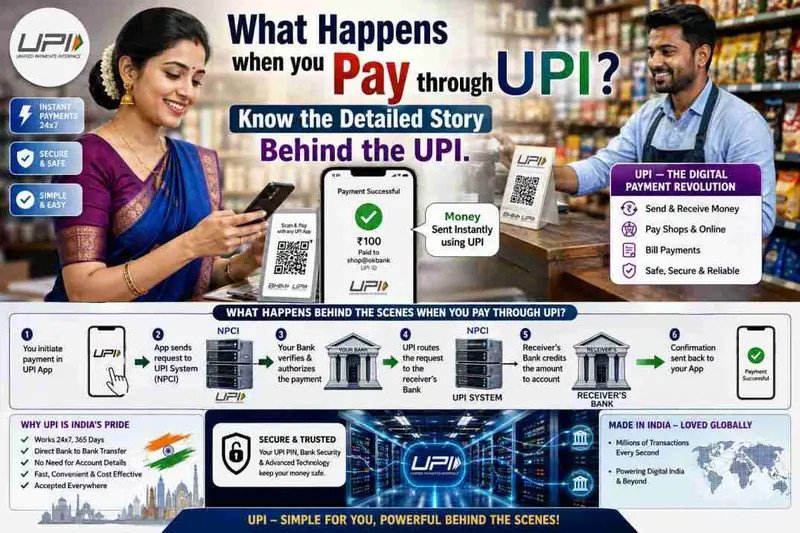
The Unified Payments Interface, better known as UPI, has completely changed the way people in India send and receive money. Today, paying a shopkeeper, splitting a restaurant bill, paying a utility bill or sending money to family can take only a few seconds. All that is usually needed is a smartphone, a UPI-enabled app and a bank account. UPI was developed by the National Payments Corporation of India (NPCI), an organisation operating under the regulatory framework of the Reserve Bank of India (RBI). It allows money to move directly between bank accounts in real time, without requiring users to share their bank account details for every transaction. NPCI describes UPI as an instant payment system built over the IMPS infrastructure.
How Did UPI Start in India?
UPI was officially launched in 2016, at a time when India was rapidly moving towards digital payments. The pilot launch took place on April 11, 2016, with 21 member banks. The idea was simple but powerful: bring different banking services together through one common payment system. Instead of remembering complicated bank details every time, customers could use a virtual payment address or other supported identifiers to send and collect money. UPI also introduced an easy way for people to make both person-to-person and merchant payments. UPI-enabled applications began becoming available to users later in 2016, and the system gradually expanded across banks, merchants and payment apps.
How Does a UPI Payment Actually Work?
The process looks simple on the phone, but several systems work together in the background. First, a user registers a bank account with a supported UPI application. After verification, the user creates or receives a UPI ID and sets a UPI PIN. When making a payment, the user can scan a QR code, enter a UPI ID, select a contact or use another available payment option. The payment request is then processed through the UPI network and the money is transferred directly between the linked bank accounts. The UPI PIN is used to authorise the transaction. NPCI says the PIN should never be shared with anyone, including people claiming to be bank or payment-app representatives.
| UPI Feature | What It Means |
|---|---|
| Real-time payments | Money can move almost instantly |
| QR payments | Scan a merchant QR code and pay |
| UPI ID | Send money without sharing full bank details |
| UPI PIN | Used to authorise transactions |
| Merchant payments | Pay shops, services and online businesses |
| UPI AutoPay | Supports eligible recurring payments |
Major Benefits of UPI for Everyday Users
The biggest strength of UPI is convenience. People do not need to carry cash everywhere, and small payments can be completed quickly. It is also useful for businesses because even small shops can accept digital payments using QR codes. Another important benefit is interoperability. A customer can generally use a supported UPI app to pay another person’s bank account even if both people use different banks or payment applications. Over time, UPI has also expanded beyond basic money transfers. Services and features have been developed for recurring payments, small-value transactions, IPO applications, feature-phone payments and voice-based interactions. NPCI’s Hello! UPI initiative, for example, is designed to make payments easier through conversational and regional-language interfaces.
UPI’s Massive Growth and India’s Digital Payment Revolution
The growth of UPI has been remarkable. NPCI’s official statistics show that in June 2026, UPI processed more than 22.7 billion transactions with a total value of about ₹28.92 lakh crore. The same data shows that 731 banks were live on the UPI platform during that month. These numbers show how deeply digital payments have become part of everyday economic activity in India. UPI has also helped bring digital payments to people who may not regularly use cards or traditional online banking. Features such as UPI 123Pay and voice-based payment services are designed to make digital transactions more accessible to people using feature phones and those who may find smartphone interfaces difficult.
UPI Goes Global: India’s Payment Technology Travels Abroad
UPI is no longer limited to domestic payments. Its international expansion has become an important part of India’s digital payment story. NPCI’s UPI Global Acceptance service allows users, where supported, to make QR-based payments at selected international merchant locations directly from eligible Indian bank accounts. The system can show the payment amount in both foreign and Indian currency, along with applicable exchange rates or fees. India is also working to make UPI more useful for international visitors. In February 2026, NPCI announced the extension of UPI One World wallet services to international delegates from more than 40 countries attending the India AI Impact Summit. The service allowed eligible visitors to make merchant payments in India without an Indian mobile number or bank account.
Why UPI Could Remain Important in the Future
UPI’s journey from a new payment system in 2016 to one of India’s most widely used digital payment platforms shows how quickly financial technology can change everyday life. Its simple interface, real-time transfers, QR payments and growing range of services have made digital payments easier for millions of people. At the same time, users must remain careful because convenience does not remove the risk of fraud. People should verify the recipient before paying, never share their UPI PIN or OTP and avoid approving unknown payment requests. As India continues expanding UPI internationally and developing new payment features, UPI is likely to remain an important part of the country’s digital economy.
FAQs
1. What is UPI in simple words?
UPI is a real-time digital payment system that allows people to send or receive money directly between bank accounts using a UPI-enabled application.
2. Is a UPI PIN safe to share?
No. A UPI PIN should never be shared with anyone. It is used to authorise transactions from your bank account.
3. Can UPI be used outside India?
Yes, UPI has international payment features in selected countries and locations. Availability depends on participating banks, apps, merchants and local regulations.