
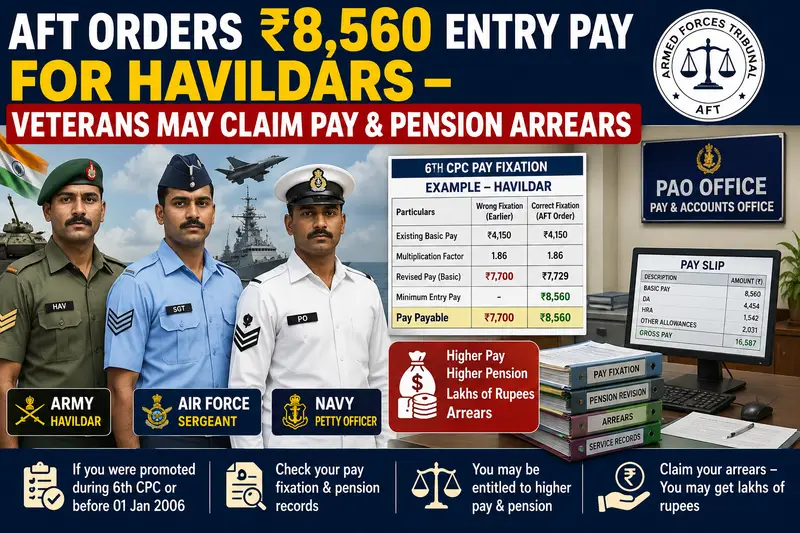
The Armed Forces Tribunal (AFT) has delivered an important judgment that brings relief to serving soldiers and retired veterans who faced issues related to pay fixation after promotion during the implementation of the Sixth Central Pay Commission (6th CPC). In its order, the Tribunal directed that a Havildar who was promoted under the Modified Assured Career Progression (MACP) and later received regular promotion should be granted an entry pay of ₹8,560 instead of the lower amount that had been fixed earlier.
The case was related to the incorrect interpretation of pay fixation rules after the introduction of the Sixth Pay Commission. According to the Tribunal, the promoted Havildar was entitled to the higher entry pay applicable to the promoted rank. The order makes it clear that eligible personnel should not suffer financial loss because of mistakes in implementing government pay rules. This decision is expected to help not only the applicant but also many other soldiers and retired defence personnel facing similar issues.
Why the Case Reached the Armed Forces Tribunal
The dispute began when the soldier’s pay was fixed at a lower stage even after he earned promotion to the rank of Havildar. He argued that as per the provisions of the Sixth Central Pay Commission, the entry pay for a Havildar in the applicable pay band should have been fixed at ₹8,560.
However, the department calculated his salary differently, resulting in lower basic pay and affecting his future financial benefits. Since pay fixation directly influences allowances, annual increments, pension, gratuity, and retirement benefits, the difference continued to impact his earnings for years.
After examining the relevant government orders and pay rules, the Armed Forces Tribunal found merit in the soldier’s claim. It held that the applicant deserved the prescribed entry pay and directed the authorities to revise the pay fixation accordingly.
What the Tribunal Ordered
The Tribunal instructed the concerned military authorities to refix the applicant’s basic pay by granting the entry pay of ₹8,560 applicable to the rank of Havildar under the Sixth Central Pay Commission. It also directed that all consequential financial benefits arising from the revised pay fixation should be extended.
This means that once the pay is corrected, other benefits linked to basic pay will also have to be recalculated.
| Particular | Details |
|---|---|
| Rank | Havildar |
| Issue | Incorrect pay fixation after promotion |
| Entry Pay Claimed | ₹8,560 |
| Tribunal Decision | Entry pay of ₹8,560 to be granted |
| Benefit | Revised pay and consequential financial benefits |
| Applicable Period | Sixth Central Pay Commission implementation |
The Tribunal’s order highlights that pay rules should be applied fairly and consistently. Employees who become eligible for higher entry pay due to promotion cannot be denied that benefit because of an incorrect interpretation of government instructions.
What This Means for Soldiers and Veterans
The judgment is significant because similar pay fixation disputes have affected many defence personnel over the years. During the implementation of the Sixth Pay Commission, several soldiers claimed that their pay had been fixed below the prescribed entry pay after promotion or financial upgradation.
For retired personnel, even a small difference in basic pay can have a lasting effect on pension and retirement benefits. Correct pay fixation may result in higher pension, improved retirement dues, and payment of arrears wherever applicable.
Serving personnel may also benefit if their cases involve the same legal principles. However, the exact benefit will depend on individual service records, date of promotion, applicable government orders, and departmental calculations. Experts believe that this decision may encourage similarly placed personnel to seek correction of their pay fixation if they were denied the prescribed entry pay.
Importance of Correct Pay Fixation Under the 6th CPC
Pay fixation is one of the most important parts of government service because every future financial benefit is calculated on the basis of basic pay. An error at the time of promotion can continue affecting an employee throughout the service period and even after retirement.
The Tribunal’s decision reinforces the principle that government employees, including soldiers, should receive the pay legally due to them under the applicable rules. It also reminds authorities that pay commission recommendations and official instructions must be implemented correctly to avoid unnecessary litigation.
For thousands of soldiers and veterans who have been raising concerns about incorrect pay fixation, this judgment provides fresh hope. While every case will still depend on its own facts and eligibility, the order strengthens the position of employees seeking fair implementation of the Sixth Central Pay Commission provisions.
FAQs
1. What relief did the Armed Forces Tribunal provide in this case?
The Tribunal directed that the promoted Havildar should receive an entry pay of ₹8,560 under the Sixth Central Pay Commission and ordered revision of his pay along with all consequential financial benefits.
2. Can other soldiers and ex-servicemen claim the same benefit?
Personnel with similar facts and pay fixation issues may rely on the legal principles laid down in the judgment. However, entitlement will depend on individual service records, promotion details, and applicable government rules.
3. Why is correct pay fixation so important?
Correct pay fixation determines basic pay, annual increments, allowances, pension, gratuity, retirement benefits, and arrears. Even a small error can affect an employee’s earnings throughout service and after retirement.