
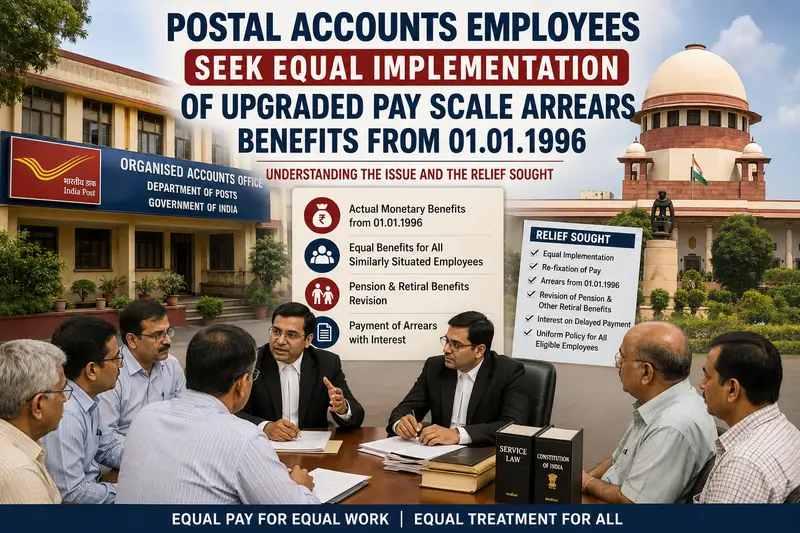
Employees of the Postal Accounts Department are once again raising concerns over the implementation of upgraded pay scale benefits. Many employees believe that although similar categories of staff have already received the benefit of upgraded pay scales, the same has not been extended uniformly to everyone who is similarly placed. As a result, employee associations have been seeking equal implementation of the upgraded pay scale, arguing that employees performing comparable duties should receive the same financial benefits. The issue has become an important service matter because it involves pay parity, equal treatment, and the proper implementation of government decisions. Employees are now hoping that the authorities will examine their representations and ensure that eligible officials receive the benefits without unnecessary delays.
What Is the Upgraded Pay Scale Issue?
The dispute revolves around the implementation of upgraded pay scales for employees working in the Postal Accounts Department. According to employee representatives, certain groups have already received revised pay benefits based on government decisions or departmental orders, while other similarly placed employees continue to wait for the same treatment.
Employees argue that differences in pay among officials performing similar duties create disparities in service conditions. They believe that once an upgraded pay scale has been approved for a particular category under the applicable rules, similarly situated employees should also receive the benefit if they satisfy the prescribed conditions.
The demand is not only about higher salary but also about maintaining fairness and consistency in government service matters.
Why Employees Are Seeking Equal Benefits
Employee associations have stated that equal implementation of pay scale benefits is essential for maintaining morale and ensuring that there is no discrimination between employees performing comparable work.
According to their representations, unequal implementation may affect not only monthly salary but also several long-term service benefits linked to basic pay. These may include retirement benefits, pension calculations, annual increments, and other financial entitlements that depend on the employee’s pay level.
Employees are therefore requesting the authorities to examine all eligible cases and extend upgraded pay scales wherever the rules permit.
Overview of the Pay Scale Issue
| Particular | Details |
|---|---|
| Department | Postal Accounts Department |
| Main Issue | Equal implementation of upgraded pay scale |
| Relief Sought | Extension of upgraded pay benefits to eligible employees |
| Employees Affected | Similarly placed officials awaiting benefit |
| Possible Impact | Salary, pension, increments, retirement benefits |
| Nature of Matter | Service-related pay parity issue |
How Upgraded Pay Scales Affect Employees
A revision in pay scale influences much more than the monthly salary. Since many service benefits are calculated on the basis of basic pay, any change in the pay scale may have a long-term financial impact throughout an employee’s career.
Some of the important areas that may be affected include:
- Monthly basic pay
- Annual increments
- Dearness Allowance calculations
- Pension and retirement benefits
- Leave encashment
- Other service-related financial benefits linked to pay
Because of these long-term implications, employees believe that delays in implementing upgraded pay scales may continue to affect them even after retirement if the issue remains unresolved.
Why Uniform Implementation Is Important
Government service rules are generally designed to ensure fairness and consistency across departments. When similarly placed employees receive different pay benefits without a valid distinction, it may lead to administrative disputes and repeated representations.
Uniform implementation of approved pay scales helps maintain transparency, reduces litigation, and improves employee confidence in the system. It also ensures that departments follow government instructions consistently instead of applying different interpretations to similar cases.
Experts believe that timely clarification by the competent authority can help avoid prolonged disputes and ensure that eligible employees receive the benefits to which they are entitled under the applicable rules.
What Employees Expect Going Forward
Postal Accounts employees are hopeful that the authorities will review their representations and examine whether similarly placed officials are entitled to the upgraded pay scale. If the issue is resolved through administrative action, it could bring greater uniformity in pay implementation and reduce the need for prolonged legal proceedings.
Employees also expect clear instructions to be issued so that future implementation remains consistent across all offices. Such clarity would help both employees and administrative authorities understand the applicable rules and minimize confusion during pay fixation.
As discussions continue, the matter remains significant because it concerns not only salary revisions but also the broader principles of equal treatment and fair implementation of government service policies. A transparent and uniform approach will be important in ensuring that deserving employees receive the benefits intended under the applicable pay rules.
FAQs
1. What is the main demand of Postal Accounts employees?
Employees are seeking equal implementation of upgraded pay scale benefits for all similarly placed officials who meet the prescribed eligibility conditions.
2. Why is the upgraded pay scale important?
An upgraded pay scale can affect monthly salary, annual increments, pension, retirement benefits, and several other service-related financial entitlements.
3. Does this issue affect only current employees?
No. Since pension and retirement benefits are often linked to basic pay, the implementation of upgraded pay scales may also have long-term implications for retired employees who are covered under the applicable rules.